



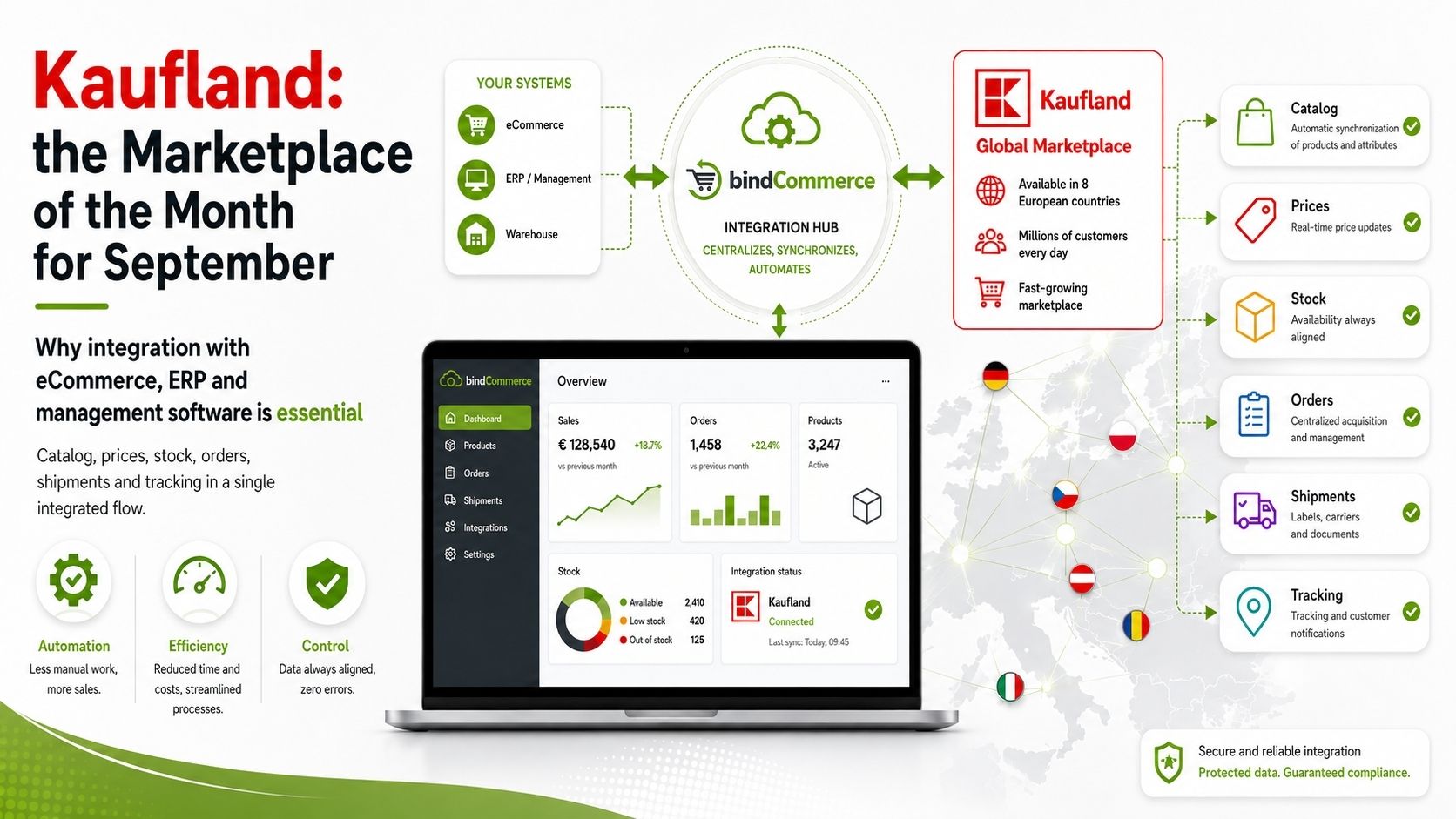
Kaufland: Marketplace of the Month for September
September is dedicated to Kaufland Global Marketplace, a platform that allows sellers to access, through a single registration, nine European marketplaces: Germany, Austria, the Czech Republic, Slovakia, Poland, France, Italy, Spain and the Netherlands. According to Kaufland, the network can offer sellers potential access to around 220 million online customers across Europe.
For a company looking to expand its international presence, Kaufland therefore represents not only an additional sales channel, but also a potential gateway to multiple European markets through a common structure.
3 months with no basic fee on Kaufland Global Marketplace
If you are considering opening an account on Kaufland Global Marketplace, you can use the promotional code reserved for new sellers:
By entering the code during registration, you can sell for 3 months with no basic fee.
- Offer valid exclusively for new Kaufland Global Marketplace sellers.
- The code must be entered during the registration process.
- The benefit is automatically credited for the first three months.
- Sales commissions still apply.
- Code valid from 1 September 2026 to 1 November 2026.
* Promotion reserved for new Kaufland Global Marketplace sellers. The promotional code must be entered during registration. Sales commissions still apply.
The real challenge, however, begins after registration: correctly publishing the catalogue, adapting product data, keeping prices and availability up to date, importing orders and sending shipping and tracking information back to the marketplace.
It is precisely at this stage that integration with business systems becomes essential.
A single ecosystem for selling across multiple European markets
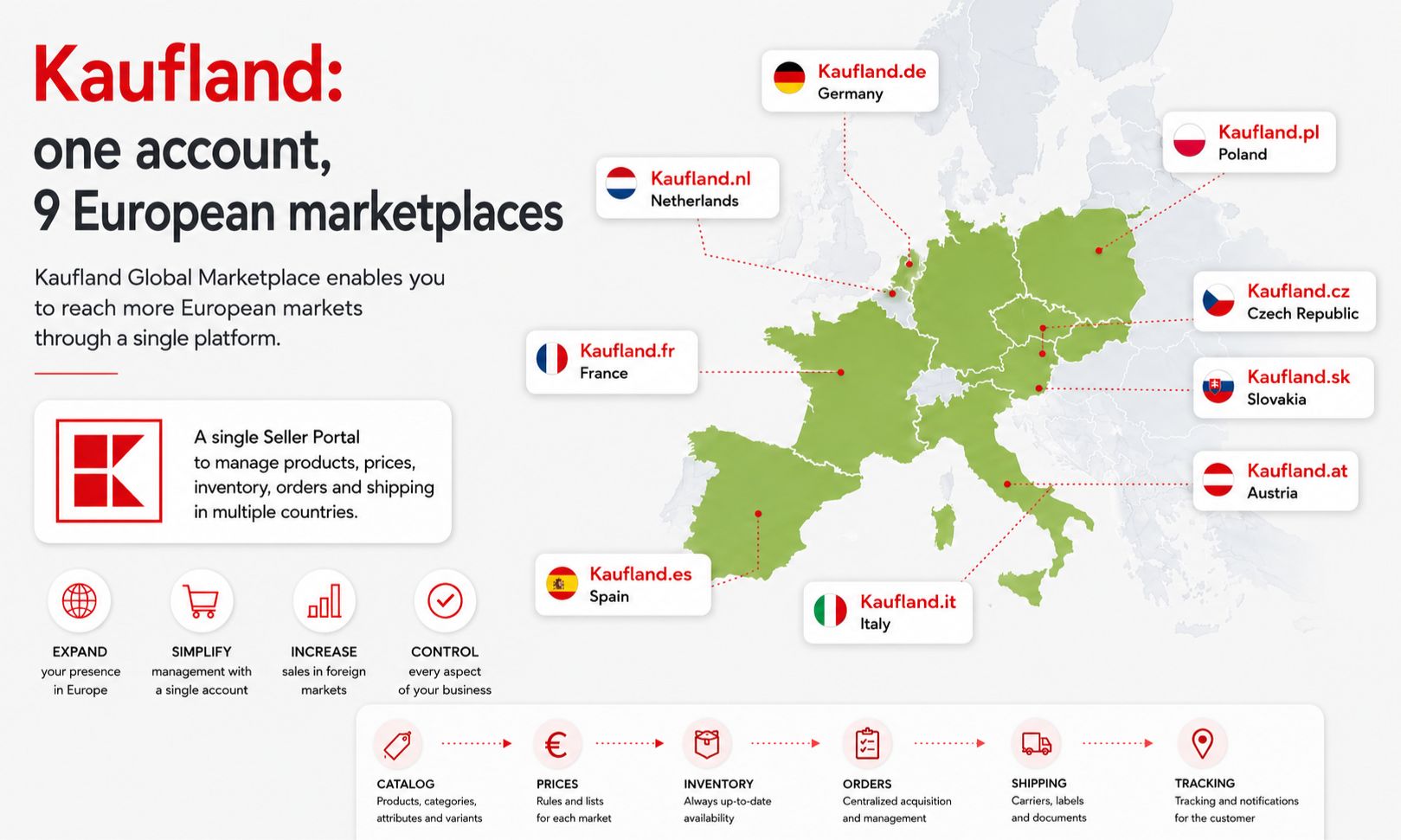
Kaufland Global Marketplace allows sellers to access different national marketplaces through a single account. The Seller Portal enables sellers to configure individual countries, publish products and offers, and manage sales-related activities.
For an Italian seller, this means being able to consider a gradual expansion, selecting the markets that best match their catalogue, pricing structure and logistics capabilities.
- Kaufland.de – Germany
- Kaufland.at – Austria
- Kaufland.cz – Czech Republic
- Kaufland.sk – Slovakia
- Kaufland.pl – Poland
- Kaufland.fr – France
- Kaufland.it – Italy
- Kaufland.es – Spain
- Kaufland.nl – Netherlands
What you need to start selling on Kaufland
Kaufland specifies a number of basic requirements for seller registration. These include operating as a commercial business, being reachable by telephone and email, not selling products belonging to prohibited categories, and having an official EAN/GTIN for the products. The seller also remains responsible for shipping goods to the end customer.
These requirements are accompanied by the tax, environmental and regulatory obligations specific to the markets in which the seller intends to operate. Rules relating, for example, to Extended Producer Responsibility may vary from country to country and depending on the product category.
Before getting started, it is therefore advisable to check:
- requirements for your product category;
- GTIN/EAN identifiers;
- tax and VAT obligations;
- any applicable EPR requirements;
- shipping and returns conditions;
- legal information required in the country of sale;
- your company's ability to manage catalogue data, availability and orders.
From your company catalogue to the Kaufland catalogue
One of the most important aspects of a marketplace project is the quality of product data. The information available in your eCommerce platform, ERP or business management system is not necessarily already organised according to the structure required by the marketplace.
To publish a product correctly, you need to manage information such as:
 Title
Title Description
 Images
 Identifier
 Category
 Attributes
 Variants
 Price
Price Availability
 Shipping
information
It is not simply a matter of translating a description: categories, attributes and commercial information may require specific adaptations for the target market.
Kaufland allows product data to be entered in the local language and offer data in the currency required by the relevant sales channel.
Categories, attributes and variants
The same product may be represented differently in company systems and on the marketplace. An ERP system, for example, may use an internal classification that does not correspond to Kaufland's category structure.
In an integrated process, the data therefore needs to be transformed:
This process may include:
 Category
mapping
 Attribute
mapping
 Variant
management
 Value
Valuenormalisation
 Information
transformation
 Required data
validation
Different prices for different markets
Selling the same product in several countries does not necessarily mean using the same price.
The strategy may vary depending on:
- logistics costs;
- taxation;
- commissions;
- local competition;
- product positioning;
- promotions;
- desired margin.
An integration allows you to start from the price stored in your business system and apply specific rules for each market.
For example:
This allows the seller to maintain a centralised pricing logic without having to manually update thousands of offers.
Availability always kept in sync
Stock management becomes even more important when the same product is sold simultaneously through an eCommerce website, on Kaufland and on other marketplaces.
Outdated availability can result in sales of products that are already out of stock, order cancellations and additional work for customer service.
With an integrated process, availability from the central system can be automatically synchronised with Kaufland.
The flow can become:
while simultaneously updating the other sales channels as well.
This helps maintain a consistent view of available stock.
Orders need to flow back into your business systems
Integration does not end with catalogue publication. When an order is received, it needs to be transferred to the system used by the company for operational management.
A typical flow might be:
The order can then enter the same process already used for the other sales channels:
 Acquisition
 Availability
check
 Preparation
 Shipping
 Tracking
generation
 Marketplace
status update
Shipping and tracking
Kaufland provides sellers with the information required for shipping, while the seller remains responsible for sending the goods to the end customer.
Once the shipment has been prepared, the information needs to be sent back to the marketplace.
With bindCommerce, the flow can be integrated to transmit:
- shipping confirmation;
- order status;
- carrier used;
- tracking code.
Kaufland and bindCommerce: an integrated flow
bindCommerce allows Kaufland Global Marketplace to be connected to the systems already used by the company.
The architecture can be represented simply as:
and, for orders:
The objective is not to replace existing systems, but to make them communicate with each other.
Through bindCommerce, it is possible to centralise and automate:
- product data;
- categories;
- attributes;
- variants;
- market-specific prices;
- availability;
- orders;
- shipping;
- tracking.
This becomes particularly useful when a company sells simultaneously on several marketplaces or manages catalogues containing large numbers of products and frequent updates.
A European marketplace, a multichannel approach
Opening a new marketplace creates new opportunities, but it also introduces new processes to manage.
When volumes are limited, many activities can be carried out manually. However, as the number of products, markets and orders increases, keeping separate processes can become inefficient.
Integration instead allows business systems to remain the main point of reference, while bindCommerce transfers and transforms the information required by Kaufland.
The result is a process in which commercial expansion does not necessarily translate into a proportional increase in manual activities.
bindCommerce × Kaufland Webinar – 30 September 2026
Would you like to learn more about Kaufland Global Marketplace?
On 30 September 2026, bindCommerce and Kaufland will hold a webinar dedicated to the opportunities offered by the marketplace and the integrated management of sales.
During the webinar, we will cover:
- how Kaufland Global Marketplace works;
- the opportunities it offers sellers;
- how to approach expansion into different European markets;
- catalogue management;
- categories, attributes and variants;
- prices and availability;
- order acquisition;
- shipping and tracking;
- integration with eCommerce platforms, ERP and business management systems.
Would you like to understand how to integrate Kaufland with your systems?
Kaufland Global Marketplace sellers can request a free, no-obligation initial assessment with the bindCommerce team. We will review your current setup, the systems you use, your catalogue and your operational processes to identify the activities that can be automated.